
Something unprecedented happened in African tech this year, and most people missed it.
African founders have quietly revolutionized startup scaling, offering a new playbook while Silicon Valley VCs focused on "capital efficiency." Their key to growth wasn't a dilutive Series B or protracted runway negotiations, but rather the strategic deployment of cold, hard, non-dilutive debt.
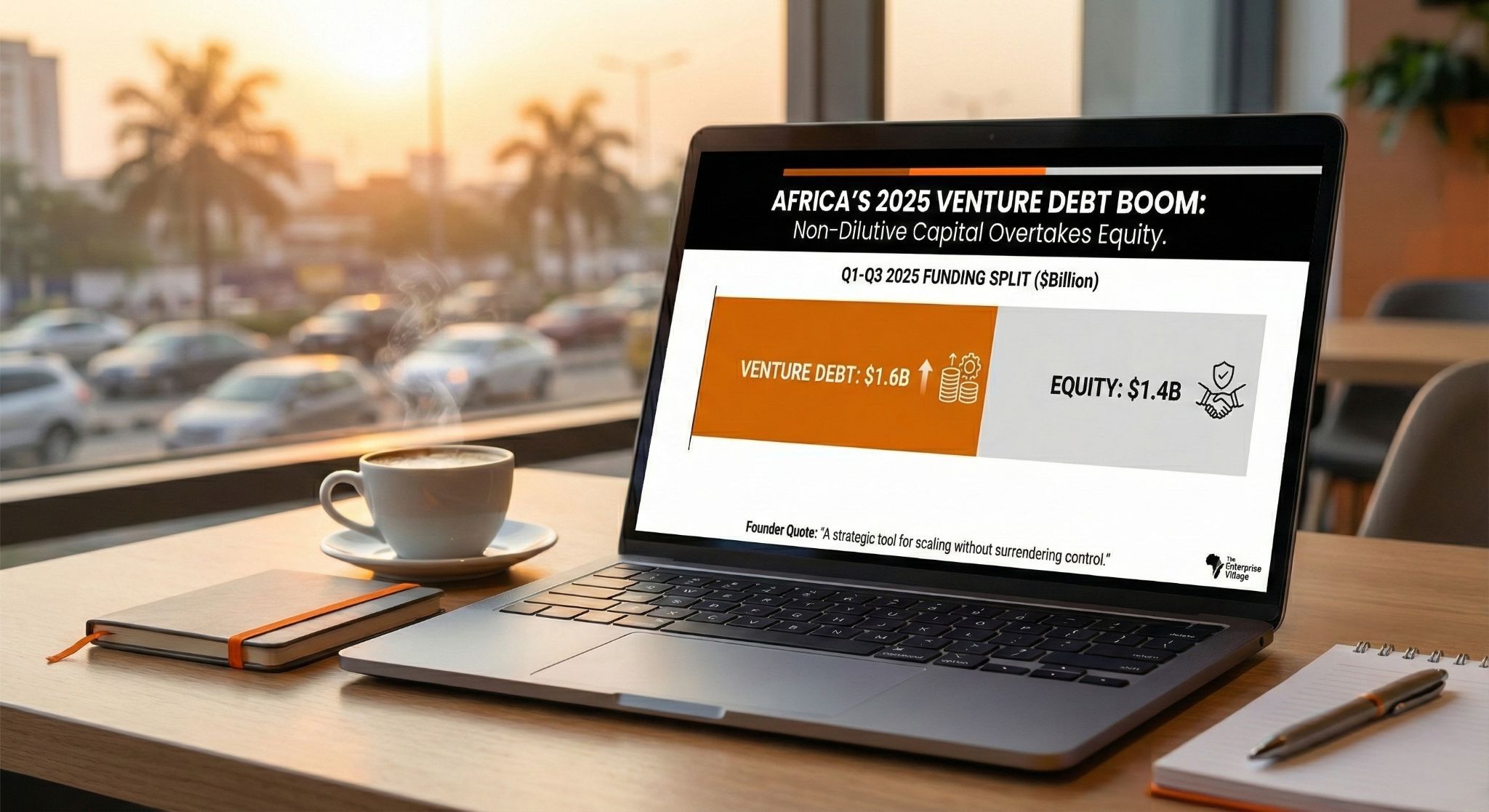
For the first time in the history of the African tech ecosystem, the "Equity is King" narrative has been dethroned.² As of Q3 2025, venture debt financing reached a staggering $1.6 billion, officially surpassing the $1.4 billion raised in traditional equity during the same period.³
Let that sink in. More debt than equity. In a single year. On a continent where "bankability" was questioned just five years ago.
This is a declaration of maturity—a signal that African startups have moved from the "prove you can survive" phase to the "prove you can compound" phase. The shift reveals something deeper: founders who lived through the 2024 downturn learned that dilution is expensive, and control is currency. They watched their peers give up 25% of their companies at flat or down valuations, and they said: Never again.
The "Venture Winter" of 2024 necessitated a focus on survival, but 2025 has ushered in the age of Non-Dilutive Growth. Debt is now seen not as the "last resort," but as the primary strategic financing option.
The surge wasn't driven by thousands of small checks. It was driven by "Mega-Debt" deals in sectors with high asset intensity and proven unit economics. Six major transactions accounted for $1.1 billion of the total debt raised this year.⁴
These weren't speculative bets. These were calculated plays by institutional capital:
- Sun King (Kenya): Secured a $156M facility to expand its off-grid solar reach across East Africa.⁵
- d.light (East Africa): Closed a massive $300M securitized facility, proving that institutional investors now view African pay-as-you-go (PAYG) receivables as a bankable asset class—on par with US auto loans.⁶
- Wave (Senegal): Raised $137M in debt, signaling that even fintech "unicorns" are choosing to protect founder equity while expanding liquidity infrastructure across francophone markets.⁷
The pattern is clear: debt flows where revenue is predictable. And in 2025, Africa's top-tier startups finally have enough transaction history to prove it.
Why Debt, Why Now?
Three tectonic forces converged in 2025 to make debt the instrument of choice:
Valuation Fatigue
After the brutal "down rounds" of 2024, founders are wary of raising equity at lower valuations.⁸ Debt allows them to reach the next milestone (Series B or C) without giving away 20% of their company at a 30% haircut. One founder told us off-record: "I'd rather pay 12% interest than sell my future at 50 cents on the dollar."
Revenue Predictability
African Fintech and Energy startups have matured. With 3–5 years of live data on user repayment rates, monthly recurring revenue, and churn, these companies can now present "predictable cash flows" to institutional lenders like Mars Growth Capital, Lendable, and Norfund. The days of "trust me, bro" pitch decks are over.
Asset-Heavy Infrastructure
You cannot build a continent-wide EV charging network, solar mini-grid, or last-mile logistics fleet on equity alone.⁹ The capital requirements are too large, the payback periods too long. Debt is the natural fuel for infrastructure—and Africa is finally building infrastructure at scale.
Kenya's Debt Dominance
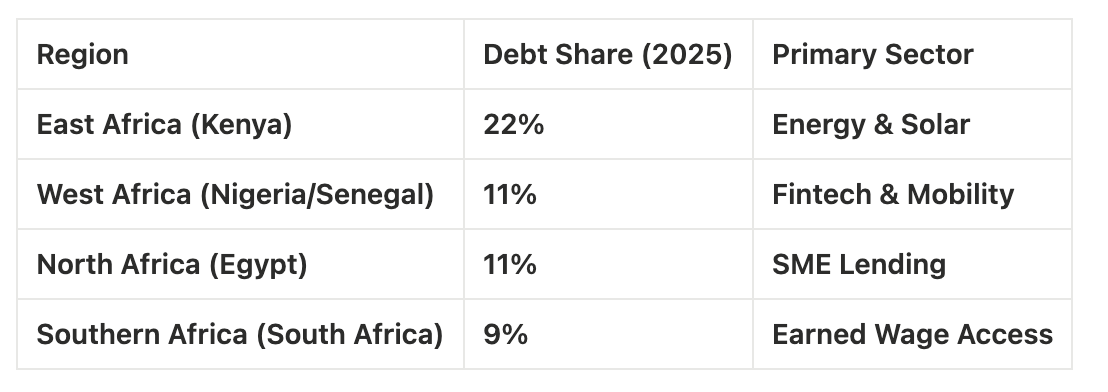
Kenya has emerged as the clear leader in this trend, accounting for 22% of all debt transactions on the continent in 2025.¹⁰ This is nearly double the share of Nigeria or Egypt.¹¹
Kenya's success is no accident. It's a direct result of its "Silicon Savannah" maturing into a hub for ClimateTech and Logistics—two sectors where debt is most effective. The Kenyan ecosystem has also benefited from regulatory clarity around digital assets and a deep bench of local institutional lenders willing to take structured credit risk.
Despite the euphoria, the "Debt Trap" remains a very real concern.
Most venture debt is still denominated in USD or EUR, while African startups earn revenue in local currencies (Naira, Shillings, Cedis).¹³
"Founders are effectively taking a bet on their country's central bank," says a Lagos-based CFO we spoke with. "If the currency devalues by 30%, your debt burden effectively grows by 30% overnight. You're not just running a startup—you're running a forex hedge fund."
The 2023–2024 Naira collapse is still fresh in memory. Companies that raised USD debt in 2022 saw their effective repayment obligations nearly double as the NGN/USD rate moved from ₦450 to ₦800+.
In response, we're seeing the rise of Local Currency Lending, with firms like Rand Merchant Bank, UBA, and Ecobank increasingly stepping into the gap previously held by foreign DFIs. Some founders are even negotiating revenue-based financing (RBF) structures tied to local currency performance metrics—a hybrid that reduces FX exposure.
The rise of debt is the ultimate sign of a maturing market.¹⁴ It shows that African startups are no longer just "experiments" looking for VC handouts; they are real businesses with assets, cash flows, audited financials, and the operational discipline to repay capital with interest.
For the "Enterprise Village" community, the message is crystal clear:
If you are building for 2026, your capital stack needs to be a hybrid. Equity for the vision. Debt for the scale. And a sharp CFO who understands the difference.